
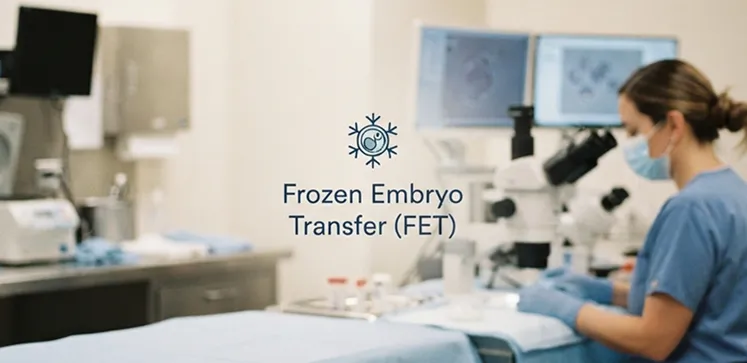
A Frozen Embryo Transfer (FET) is a fertility treatment that uses an embryo frozen during a previous IVF cycle.
The frozen embryo is carefully thawed and transferred into the uterus when the timing is right.
FET can be used when couples have stored embryos or when a fresh embryo transfer is not the preferred option.
A Frozen Embryo Transfer, often shortened to FET, is a procedure where a frozen embryo is carefully thawed and placed inside the uterus using a thin catheter.
Embryos are usually frozen after IVF or intracytoplasmic sperm injection (ICSI). They can then be stored for future treatment.
During an FET cycle, the fertility team prepares the endometrium, or uterine lining, so it is ready for embryo implantation.
The embryo is then transferred into the uterus at the appropriate stage of the menstrual cycle.
There are several reasons a fertility specialist may recommend FET.
For example, a couple may have additional embryos remaining after an IVF cycle. Rather than discarding suitable embryos, they can be frozen and preserved for future use.
FET may also be used when:
The FET process is generally simpler than the original IVF process because it doesn’t require egg collection.
First, the fertility team prepares the uterus. Depending on the type of FET cycle, this may happen naturally or with fertility medications.
The clinic monitors the uterine lining and ovulation or hormone levels. When the timing is appropriate, an embryo is thawed in the laboratory.
If the embryo survives the thawing process and is considered suitable for transfer, it is placed into the uterus through a thin catheter. The procedure usually takes only a short time.
The best FET approach depends on factors such as menstrual cycles, ovulation, hormone levels, and previous infertility treatment.
A natural FET cycle uses the person’s natural menstrual cycle.
The fertility team monitors follicle development and ovulation through ultrasound and sometimes blood tests.
The embryo transfer is then timed according to natural ovulation.
A modified natural cycle also follows natural ovulation but may use medication, commonly an hCG trigger injection, to help control or predict ovulation timing.
This can make scheduling the embryo transfer easier.
A medicated FET cycle, sometimes called a hormone replacement cycle, uses medications such as estrogen and progesterone to prepare the uterine lining and support implantation.
This approach can be useful when natural ovulation is irregular, absent, or difficult to monitor.
The exact timeline varies from person to person, but an FET cycle commonly follows these stages:
The timing is particularly important because the embryo and uterine lining need to be at the right developmental stage for implantation.
On the day of the transfer, the embryo is thawed and assessed by the embryology team.
During the procedure, you usually lie on an examination table. A speculum is used to gently access the cervix. The fertility specialist then passes a very thin catheter through the cervix and into the uterus.
The embryo is released into the uterine cavity.
Anesthesia is generally not needed, although experiences can vary. Some people experience mild cramping or pressure, while others feel very little discomfort.
FET success rates vary considerably, and there is no single success rate that applies to everyone.
Important factors include:
A major advantage of looking at FET success is that the embryo’s characteristics and the patient’s individual circumstances can be considered together rather than relying on one general percentage.
FET offers several potential advantages.
FET is generally considered a safe fertility procedure, but it is not completely risk-free.
Possible side effects may come from medications rather than the embryo transfer itself. These can include bloating, breast tenderness, headaches, mood changes, or mild abdominal discomfort.
There is also a possibility that an embryo may not survive thawing, although modern embryo-freezing techniques have high survival rates.
As with pregnancy generally, there can also be risks such as ectopic pregnancy or miscarriage. Your fertility specialist can explain your individual risks.
Your gynaecology clinic will provide specific instructions, but preparation may include taking prescribed medications exactly as directed and attending scheduled ultrasound or blood test appointments.
It is also helpful to:
You generally do not need to make major lifestyle changes immediately before an FET. Consistency and following your clinic’s instructions are more important.
After the transfer, you can usually return to normal daily activities unless your clinic recommends otherwise.
Some people notice mild cramping, spotting, bloating, or breast tenderness. These symptoms can also be caused by progesterone or other medications, so they do not reliably indicate whether implantation has occurred.
Try not to interpret every physical sensation as a sign of pregnancy. The pregnancy test is the more reliable way to determine the outcome.
If your pregnancy test is positive, the clinic may arrange follow-up blood tests to assess hCG levels.
An early pregnancy ultrasound is usually scheduled later to confirm the pregnancy’s location and development.
If everything is progressing normally, ongoing pregnancy care will eventually move from the fertility clinic to your usual maternity or obstetric care.
A failed FET can be emotionally difficult, but it does not necessarily mean that future treatment will fail.
Your IVF specialist clinic may review factors such as embryo quality, uterine lining development, timing, hormone levels, and your previous treatment history.
If additional frozen embryos are available, another transfer may be possible. In other situations, your doctor may recommend further testing or changes to the treatment plan.
The next step should be based on your individual history rather than assuming that one unsuccessful transfer explains the outcome.
The cost of frozen embryo transfer varies between fertility clinics and countries. It can depend on whether the quoted price includes consultations, ultrasound monitoring, medications, embryo thawing, laboratory fees, and the transfer procedure.
Additional costs may apply for embryo storage or genetic testing.
Before starting treatment, ask the clinic for a detailed cost breakdown so you understand what is included and what may be charged separately.
FET has become an important part of modern fertility treatment because it allows previously created embryos to be used when the uterus and overall circumstances are considered suitable.
However, the best FET protocol is not the same for everyone.
A fertility specialist clinic can assess your menstrual cycle, uterine health, embryo characteristics, previous treatment, and other factors before recommending a natural, modified natural, or medicated cycle.
A Frozen Embryo Transfer (FET) uses a previously frozen embryo for pregnancy treatment. It can provide another opportunity to achieve pregnancy after IVF without repeating egg retrieval for every transfer.
From preparing the uterine lining to thawing the embryo and carefully timing the transfer, each stage is designed to give the embryo the best possible environment for implantation.
If you are considering FET, discussing your individual circumstances with a qualified fertility specialist is the best way to understand which protocol, timing, and treatment approach may be appropriate for you.


