
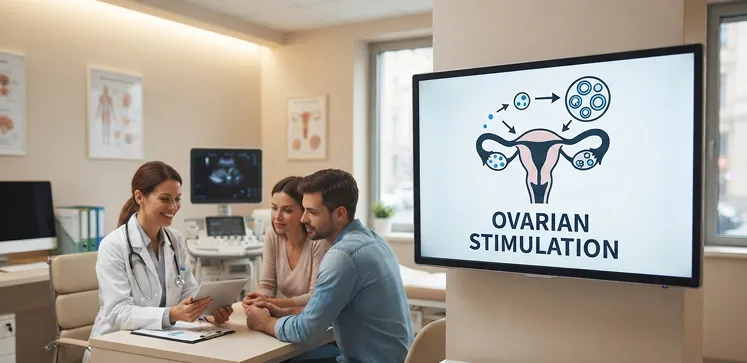
Ovarian stimulation is a fertility treatment that uses medication to help the ovaries develop mature eggs. It is often used when ovulation is irregular or as part of fertility treatments.
Doctors may recommend ovarian stimulation for IUI or IVF, depending on the person’s fertility needs and treatment goals.
During treatment, doctors closely monitor the ovaries to see how the follicles grow. Doctors can then adjust the medication and dose to support a safe, effective response.
Ovarian stimulation is a controlled fertility treatment that uses medication to stimulate the ovaries to develop one or more ovarian follicles.
A follicle is a small fluid-filled structure in the ovary that contains a developing egg.
During a natural menstrual cycle, hormones usually lead one follicle to become dominant and release an egg during ovulation.
With ovarian stimulation, fertility specialists use medications to influence this process.
The goal is not simply to produce as many eggs as possible. Instead, treatment is carefully adjusted to achieve an appropriate ovarian response while reducing the risk of complications.
Ovarian stimulation may be recommended for several fertility situations, including:
For IUI, stimulation may increase the number of mature follicles available for ovulation.
For IVF, the aim is usually to develop multiple mature follicles so that several eggs can potentially be collected during egg retrieval.
Ovarian stimulation uses fertility medicines to help the ovaries develop mature follicles. The process is usually done in a few simple steps:
The goal is to support healthy follicle development while keeping the treatment safe and controlled.
The medicines used depend on the treatment plan. Common options include:
A fertility specialist chooses the medication and dose based on factors such as age, ovarian reserve, previous treatment response, and the type of fertility treatment being performed.
Before stimulation begins, the fertility team usually reviews medical history, menstrual cycles, previous fertility treatment, and reproductive goals.
Testing may include an ultrasound, ovarian reserve testing, and hormone blood tests.
These assessments help the doctor decide whether stimulation is appropriate and how the cycle should be managed.
Medication is started according to the treatment protocol. Some medicines are taken by mouth, while others are given by injection.
The timing and dosage are important, so patients should follow their gynaecology clinic’s instructions carefully.
During treatment, ultrasound scans are used to check follicle development. Blood tests may also measure hormones such as estradiol.
Monitoring helps the medical team see how the ovaries are responding and whether follicles are developing at the expected rate.
Not every person responds to stimulation in the same way. The doctor may increase, decrease, or otherwise adjust medication depending on follicle growth and hormone levels.
If the ovaries respond too strongly, treatment may need to be modified to reduce the risk of complications.
When the follicles are ready, a trigger medication may be given. Depending on the treatment, this helps complete final egg maturation or triggers ovulation.
Timing is especially important because IUI or egg retrieval must be scheduled around this stage.
For IUI, ovulation is timed so prepared sperm can be placed directly into the uterus around the fertile window.
For IVF, the mature eggs are collected through a procedure called egg retrieval. The eggs can then be fertilized in the laboratory.
Monitoring commonly involves transvaginal ultrasound and, when appropriate, blood tests.
Ultrasound allows the fertility specialist to assess the number and size of developing follicles. Hormone testing can provide additional information about ovarian response.
This monitoring is important because treatment needs to balance follicle development with patient safety.
The length varies depending on the treatment protocol and individual response.
For many IVF cycles, injectable ovarian stimulation lasts around 8 to 14 days, although some treatment plans may be shorter or longer.
IUI stimulation can also vary depending on the medication used and how quickly follicles develop.
Your fertility clinic will provide a specific schedule based on your cycle.
Some people experience very few symptoms, while others notice physical changes as the ovaries respond to medication.
You may experience:
As multiple follicles grow, the ovaries can become temporarily enlarged, which may contribute to feelings of fullness or bloating.
Ovarian stimulation is generally well tolerated, but some people may notice mild side effects as the ovaries respond to the medication.
Common side effects include:
These symptoms are often temporary and improve after treatment.
However, tell your fertility team if you have severe pain, rapid swelling, trouble breathing, or symptoms that suddenly get worse.
Ovarian stimulation is generally safe when it is carefully monitored, but some risks can occur. The main ones include:
Regular ultrasound scans and hormone tests help doctors monitor the response and adjust treatment when needed.
Severe or rapidly worsening symptoms should be reported to the fertility team promptly.
The purpose of stimulation is different in IVF and IUI, even though both treatments may use fertility medicines.
Feature | Ovarian Stimulation for IUI | Ovarian Stimulation for IVF |
Main goal | Encourage controlled ovulation | Develop multiple mature follicles |
Eggs | Usually released naturally | Collected during egg retrieval |
Fertilization | Takes place inside the body | Takes place in a laboratory |
Monitoring | Ultrasound and sometimes blood tests | Frequent ultrasound and hormone monitoring |
Next step | Timed IUI | Egg retrieval and embryo creation |
Ovarian stimulation may be recommended when someone needs help with ovulation or is undergoing fertility treatment such as IUI or IVF.
It may be considered for people with:
However, it is not right for everyone.
A fertility specialist will look at factors such as age, ovarian reserve, hormone levels, fertility history, sperm health, and overall health before choosing the best treatment approach.
Several factors can influence how well the ovaries respond, including:
Importantly, producing more follicles does not automatically mean a higher chance of pregnancy.
The quality of the eggs, sperm, embryo development, and other reproductive factors also matter.
Natural ovulation occurs through the body’s own hormonal cycle, while ovarian stimulation uses fertility medication to influence follicle development or ovulation.
Feature | Natural Ovulation | Ovarian Stimulation |
Hormonal control | Mainly natural | Medically controlled or supported |
Follicles | Usually one dominant follicle | One or multiple follicles may develop |
Monitoring | Usually minimal | Ultrasound and sometimes blood tests |
Medication | None | Oral or injectable fertility medicines |
Timing | Natural cycle | Can be medically timed |
Before starting treatment, make sure you understand your medication schedule, injection technique if applicable, monitoring appointments, and the timing of IUI or egg retrieval.
Take medicines exactly as prescribed and tell your fertility team about other medications or supplements you use.
Maintaining healthy habits, attending monitoring appointments, and communicating any concerning symptoms can also help make the treatment process safer and easier to manage.
Ovarian stimulation is a carefully monitored fertility treatment designed to support follicle development, egg maturation, or ovulation. It can be used on its own for ovulation treatment or as part of procedures such as IUI and IVF.
Because every person responds differently, there is no single stimulation protocol that works for everyone. A fertility specialist uses your test results and treatment goals to choose the appropriate medication, dose, and monitoring plan.
If you are considering ovarian stimulation, discussing your options with a qualified fertility specialist is the best way to understand which approach may be appropriate for you.


