
What is an IVF Cycle A Complete Guide to the IVF Process

What is an IVF Cycle? A Complete Guide to the IVF Process

An IVF cycle is a fertility treatment that helps sperm and egg meet in a laboratory to create an embryo. The embryo can then be transferred into the uterus to achieve pregnancy.

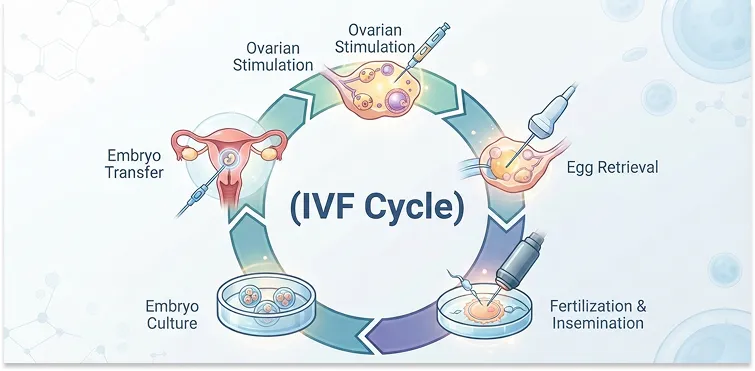
The IVF process includes several stages, including fertility assessment, ovarian stimulation, egg retrieval, fertilisation, embryo development, and embryo transfer.

Understanding each stage of an IVF cycle can help you know what to expect and feel more prepared for treatment.

Table of Contents

What Is an IVF Cycle?

An IVF cycle is a fertility treatment in which eggs are collected from the ovaries and fertilised with sperm in a laboratory to create embryos. 

A suitable embryo may then be transferred into the uterus to attempt pregnancy.

Several eggs may be collected during one cycle, and more than one embryo may develop. Suitable embryos that are not transferred can often be frozen for future treatment.

Throughout the process, a fertility specialist and clinical team monitor your progress and adjust the treatment according to your individual needs.

What Are the Steps of an IVF Cycle?

Although protocols differ between patients and fertility clinics, a typical IVF cycle includes the following stages.

1. Initial fertility assessment

Before starting IVF, your fertility specialist will review your medical history, menstrual cycle, previous fertility treatments, and any known reproductive conditions.

Tests may include blood tests, an ultrasound scan, and an ovarian reserve assessment to understand your fertility health.

For male partners, a semen analysis may be used to assess sperm count, motility, and morphology. These results help the fertility team choose an IVF treatment plan that best suits your individual needs.

2. Ovarian stimulation

During a natural menstrual cycle, the ovaries usually develop one dominant egg. IVF uses fertility medications to encourage the ovaries to produce several mature eggs during the same cycle.

These medicines often contain hormones called gonadotropins and are usually given as injections for several days.

The aim is to develop multiple healthy follicles while keeping the treatment safe and controlled.

3. Monitoring Follicle and Egg Development

Throughout ovarian stimulation, your fertility team closely monitors how your ovaries are responding to the medication.

This usually involves transvaginal ultrasound scans and blood tests at different points during treatment.

The scans help measure the growing follicles and assess the uterine lining. Based on your results, your specialist may adjust your medication dose or treatment schedule.

4. Trigger Injection

Once the follicles have reached the appropriate size, you will receive a trigger injection.

This helps the eggs complete their final stage of maturation so they are ready for collection.

Egg retrieval is carefully scheduled after the trigger injection, usually around 34–36 hours later.

The exact timing depends on your treatment plan and your clinic’s protocol.

5. Egg Retrieval

Egg retrieval, also known as oocyte retrieval, is the procedure used to collect mature eggs from the ovaries. A thin needle is guided through the vagina into the ovarian follicles, usually with the help of ultrasound.

The procedure is typically performed with sedation or anaesthesia to keep you comfortable.

Once collected, the eggs are taken to the laboratory where they are assessed and prepared for fertilisation.

6. Sperm Collection and Preparation

A sperm sample is usually provided around the time of egg retrieval.

In the laboratory, the sample is processed to identify sperm with suitable movement and characteristics for fertilisation.

When there are certain male infertility factors, intracytoplasmic sperm injection (ICSI) may be recommended. With ICSI, a single sperm is carefully injected directly into a mature egg.

7. Fertilisation in the Laboratory

After the eggs and sperm have been prepared, fertilisation takes place in the fertility laboratory. Depending on the treatment plan, the eggs may be fertilised using conventional IVF or ICSI.

The embryology team then checks the eggs for signs of fertilisation.

Successfully fertilised eggs can continue developing into embryos, which are monitored closely in the laboratory.

8. Embryo Development and Culture

After fertilisation, the embryos are kept in carefully controlled laboratory conditions while they develop. Embryologists monitor their growth and development over the following days.

Not every fertilised egg will continue developing into a suitable embryo.

Depending on your circumstances and treatment plan, suitable embryos may be transferred, frozen for future use, or considered for additional testing.

9. Embryo Transfer

Embryo transfer is the stage where a selected embryo is placed into the uterus. A thin, flexible catheter is gently passed through the cervix to transfer the embryo into the womb.

The procedure is generally straightforward and does not usually require anaesthesia.

In some cases, embryos are frozen and transferred during a later cycle through a frozen embryo transfer (FET).

10. Pregnancy Test

After embryo transfer, there is a waiting period before you take a pregnancy test.

Your IVF treatment clinic will tell you when to test, as testing too early may give an inaccurate result.

If the test is positive, your fertility clinic may arrange blood tests and an early ultrasound scan to check that the pregnancy is developing as expected.

What Happens During Each Stage of IVF?

An IVF cycle follows several simple steps, from preparing the ovaries to transferring an embryo into the uterus.

The main stages include:

  1. Fertility assessment – Your fertility health is checked.
  2. Ovarian stimulation – Medication helps the ovaries produce several eggs.
  3. Egg retrieval – Mature eggs are collected from the ovaries.
  4. Fertilisation – Eggs are combined with sperm in the laboratory.
  5. Embryo development – Fertilised eggs develop into embryos.
  6. Embryo transfer – A suitable embryo is placed into the uterus.
  7. Pregnancy test – Testing confirms whether pregnancy has occurred.

Not every egg will fertilise or develop into an embryo.

This is a normal part of the IVF process, and your fertility team will monitor each stage closely.

How Many Eggs Are Needed for IVF?

There is no fixed number of eggs needed for IVF. The number collected can be different for each person, and having more eggs does not always mean better results.

The number of eggs collected can depend on:

  • Age
  • Ovarian reserve
  • Fertility condition
  • Response to IVF medication
  • Egg quality

Your IVF specialist clinic will consider these factors together.

Egg quality and embryo development are also important when looking at the chances of IVF success.

How Long Does an IVF Cycle Take From Start to Finish?

A typical IVF cycle takes several weeks, but the exact time can vary from person to person.

Your treatment plan, medication response, and whether you have a fresh or frozen embryo transfer can affect the timeline.

The main stages usually include:

  • Fertility assessment and planning
  • Ovarian stimulation: Around 1–2 weeks
  • Egg retrieval: Usually about 34–36 hours after the trigger injection
  • Embryo development: Several days
  • Embryo transfer: Either during the same cycle or in a later cycle
  • Pregnancy test: Usually around 10–14 days after transfer

Your infertility treatment clinic will give you a personalised timeline based on your treatment plan.

ALICE Test in London

What Are the Possible Side Effects and Risks of IVF?

IVF is generally safe, but the medicines and procedures can cause some side effects and risks.

Most are temporary and can be managed with guidance from your fertility team.

Common side effects and possible risks include:

  • Bloating and abdominal discomfort
  • Headaches and tiredness
  • Mood changes
  • Breast tenderness
  • Ovarian hyperstimulation syndrome (OHSS)
  • Bleeding or infection after egg retrieval
  • Multiple pregnancy, particularly when more than one embryo is transferred

Your gynaecology clinic will monitor you throughout the cycle to reduce these risks and explain which side effects you should watch for.

How Much Does an IVF Cycle Cost?

The cost of an IVF cycle can vary depending on the fertility clinic, location, treatment plan, and medications you need.

Some clinics include most treatment costs in one package, while others charge separately for medication, tests, procedures, or additional services.

The total cost may include:

  • Initial fertility tests and consultations
  • IVF medications
  • Egg retrieval
  • Laboratory fertilisation and embryo culture
  • Embryo transfer
  • Embryo freezing and storage
  • Additional treatments such as ICSI, when needed

Before starting treatment, ask your clinic for a full cost breakdown, so you know what is included and whether there may be additional charges.

What Are the Chances of Success With IVF?

For IVF, success rates are often reported by age group because age has a major effect on egg quality and pregnancy outcomes. 

For example, clinics may report live birth rates of approximately 30–40% per embryo transfer for women under 35, compared with around 10–15% for women aged 40–42.

Other factors can also affect the outcome, including:

  • Egg quality and ovarian reserve
  • Sperm quality
  • Embryo quality
  • Cause of infertility
  • Previous IVF results
  • Uterine health

Your fertility specialist can use these factors to estimate your individual chances.

Importantly, live birth rates are different from pregnancy rates, so always check which outcome a clinic’s percentage represents.

What Happens After an IVF Cycle?

After an embryo transfer, you usually wait 10–14 days before taking a pregnancy test.

During this time, you may continue taking prescribed medicines, such as progesterone, and follow your clinic’s instructions.

The next steps depend on the result:

  • Positive test: Your clinic may arrange a blood test and an ultrasound scan at around 6–7 weeks of pregnancy.
  • Negative test: Your specialist may review the cycle and discuss your options for future treatment.
  • Frozen embryos available: Suitable embryos may be stored for use in a future frozen embryo transfer (FET).

What Are the Possible Side Effects and Risks of IVF?

IVF is generally safe, but the medicines and procedures can cause some side effects and risks.

Most are temporary and can be managed with guidance from your fertility team.

Common side effects and possible risks include:

  • Bloating and abdominal discomfort
  • Headaches and tiredness
  • Mood changes
  • Breast tenderness
  • Ovarian hyperstimulation syndrome (OHSS)
  • Bleeding or infection after egg retrieval
  • Multiple pregnancy, particularly when more than one embryo is transferred

Your gynaecology clinic will monitor you throughout the cycle to reduce these risks and explain which side effects you should watch for.

How Many IVF Cycles May Be Needed?

Some people achieve pregnancy after one IVF cycle, while others may need 2–3 cycles or more.

No fixed number works for everyone, as success depends on factors such as age, egg quality, sperm quality, and embryo development.

Your fertility specialist may recommend another cycle if the first attempt is unsuccessful.

They can review your previous results and decide whether changes to the medication, fertilisation method, or embryo transfer plan could improve your chances in a future cycle.

Conclusion

An IVF cycle is a carefully planned process that takes eggs through several stages, from ovarian stimulation and egg retrieval to laboratory fertilisation, embryo development, embryo transfer, and pregnancy testing.

While the process can seem complicated at first, understanding each stage can make it easier to prepare for treatment. Importantly, every IVF journey is different, and your fertility specialist will tailor the treatment protocol to your needs.

If you are considering IVF, a detailed fertility assessment is the best starting point for understanding which treatment approach may be appropriate for you.