
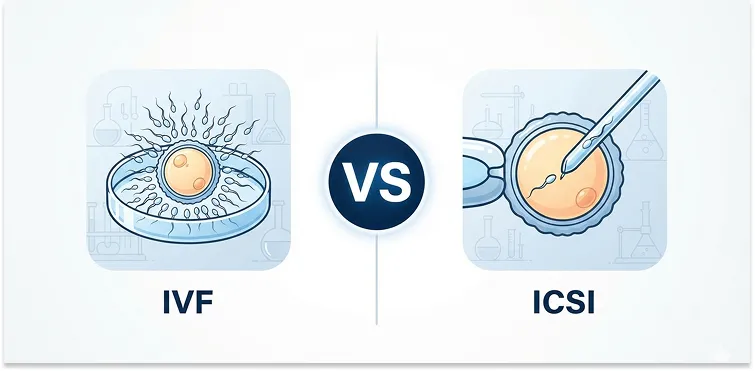
Choosing between IVF and ICSI can be confusing when you are already facing difficulties with conception.
Both treatments can help with fertilisation, but they work in different ways.
You may wonder which option is more suitable, especially if you have concerns about sperm quality, success rates, cost, or treatment time.
This guide compares IVF vs. ICSI to help you understand how they work, who may benefit, their success rates, costs, risks, and other key differences.
Understanding the key differences between IVF and ICSI can help you see which approach may better suit your fertility needs.
Feature | IVF | ICSI |
Fertilisation | Sperm fertilises the egg naturally | Sperm is injected into the egg |
Main use | Used for many fertility problems | Used when fertilisation may be difficult |
Sperm needed | Many sperm are needed | One suitable sperm is selected |
Fertilisation method | Eggs and sperm are combined | Sperm is injected into each mature egg |
Male infertility | May help in mild cases | Often used for male factor infertility |
Previous fertilisation failure | May not be preferred after failed fertilisation | May be considered after failed IVF fertilisation |
Egg retrieval | Required | Required |
Embryo development | Embryos grow in the lab | Embryos grow in the lab |
Embryo transfer | Embryo is transferred to the uterus | Embryo is transferred to the uterus |
Treatment time | Usually similar | Usually similar |
Laboratory work | Standard fertilisation process | Requires sperm injection |
Cost | Usually lower | Usually higher |
Best suited for | Many couples needing assisted reproduction | Selected couples with fertilisation concerns |
Before comparing their suitability, success rates, and costs, it helps to understand how IVF and ICSI work and what sets each treatment apart.
In vitro fertilisation (IVF) is a fertility treatment where eggs are collected from the ovaries and combined with sperm in a laboratory.
If fertilisation occurs, the resulting embryo is monitored as it develops. A suitable embryo can then be transferred into the uterus.
IVF may be used for conditions such as blocked fallopian tubes, endometriosis, unexplained infertility, and some male fertility problems.
Intracytoplasmic sperm injection (ICSI) is a specialised form of IVF. Instead of placing sperm and eggs together, an embryologist injects one selected sperm directly into a mature egg.
After fertilisation, the embryo develops in the laboratory in much the same way as with conventional IVF.
A suitable embryo can then be transferred into the uterus.
The early stages of IVF and ICSI are largely similar. The biggest difference happens during fertilisation.
During conventional IVF treatment:
This approach allows sperm to fertilise the egg without direct injection.
ICSI treatment follows similar ovarian stimulation and egg retrieval steps. However, the fertilisation stage is different.
An embryologist carefully selects a sperm and injects it directly into a mature egg. The fertilised egg is then monitored as it develops into an embryo.
This can help overcome certain problems that make it difficult for sperm to fertilise an egg on its own.
The choice between IVF and ICSI often depends on the underlying fertility concerns and how likely each treatment is to support successful fertilisation.
Conventional IVF may be considered when:
ICSI may be considered when fertilisation may be difficult, especially due to male factor infertility:
One of the most common reasons for using ICSI is male factor infertility. Low sperm count, reduced sperm movement, or abnormal sperm shape can make conventional fertilisation more difficult.
Because ICSI requires only one sperm for each mature egg, it can be useful in selected cases where sperm cannot easily fertilise an egg without assistance.
However, ICSI is not automatically necessary for every couple with male infertility. A fertility specialist will usually consider the semen analysis and the couple’s overall circumstances before recommending it.
While both treatments can lead to pregnancy, their success can vary depending on factors such as age, egg and sperm quality, and the reason for infertility
IVF success depends on much more than the fertilisation technique. Age, egg quality, sperm quality, embryo development, and the cause of infertility can all influence the outcome.
A successful fertilisation does not necessarily mean a pregnancy will occur, because an embryo must also implant successfully in the uterus.
ICSI can improve the chance of fertilisation when sperm-related problems make conventional IVF fertilisation less likely.
However, ICSI does not necessarily mean a higher overall pregnancy or live birth rate for everyone. If sperm can already fertilise eggs effectively, the additional injection may not provide a meaningful advantage.
Important factors include:
This is why comparing IVF and ICSI based on a single success-rate figure can be misleading.
Cost can also play an important role in deciding between IVF and ICSI, with the two treatments differing in their overall expenses.
The cost of IVF can include consultations, fertility medications, monitoring, egg collection, laboratory fertilisation, embryo culture, and embryo transfer.
The total price varies between gynaecology clinics and may also depend on the treatment plan.
ICSI generally costs more than conventional IVF because it requires an additional laboratory procedure.
The embryologist must identify individual sperm and inject them into the eggs using specialised equipment.
When comparing treatment prices, ask whether the quoted fee includes:
Looking at the full treatment cost, rather than only the advertised package price, can give you a clearer picture.
The overall timeline for IVF and ICSI is usually quite similar because both generally involve ovarian stimulation, egg retrieval, embryo development, and embryo transfer.
An IVF cycle usually takes several weeks from preparation to embryo transfer. It includes ovarian stimulation, regular monitoring, and egg retrieval.
After retrieval, the eggs are fertilised in the laboratory and embryos are monitored as they develop. A suitable embryo may then be transferred to the uterus.
ICSI follows almost the same schedule. The main difference is the additional laboratory step performed after egg retrieval.
Therefore, ICSI is not necessarily a longer treatment for the patient, although laboratory preparation can differ between clinics and individual treatment plans.
Understanding the potential risks and side effects of each treatment can help you make a more informed choice based on your individual fertility needs.
IVF may cause side effects related to fertility medication, such as bloating, breast tenderness, headaches, or mood changes.
Egg retrieval is also an invasive procedure and carries small risks such as bleeding or infection.
Ovarian stimulation can rarely lead to ovarian hyperstimulation syndrome (OHSS).
ICSI has many of the same risks as IVF because most of the treatment process is identical.
There is also a small risk that an egg may be damaged during sperm injection.
Additionally, while ICSI can overcome certain sperm-related fertilisation problems, it does not eliminate all causes of infertility or guarantee pregnancy.
There is no universal winner between IVF and ICSI.
The most appropriate option depends on the specific fertility diagnosis and the likelihood of successful fertilisation.
Conventional IVF may be a reasonable option when:
ICSI may be more appropriate when:
IVF and ICSI differ mainly in how fertilisation takes place. IVF combines sperm and eggs, while ICSI injects one sperm directly into the egg.
IVF may suit many couples, while ICSI can be helpful when there are sperm-related or previous fertilisation problems.
The right choice depends on your fertility history, egg and sperm quality, age, and diagnosis. A fertility specialist can help you choose the most suitable option.


