
Comprehensive assessment and individualised treatment for uterine fibroids
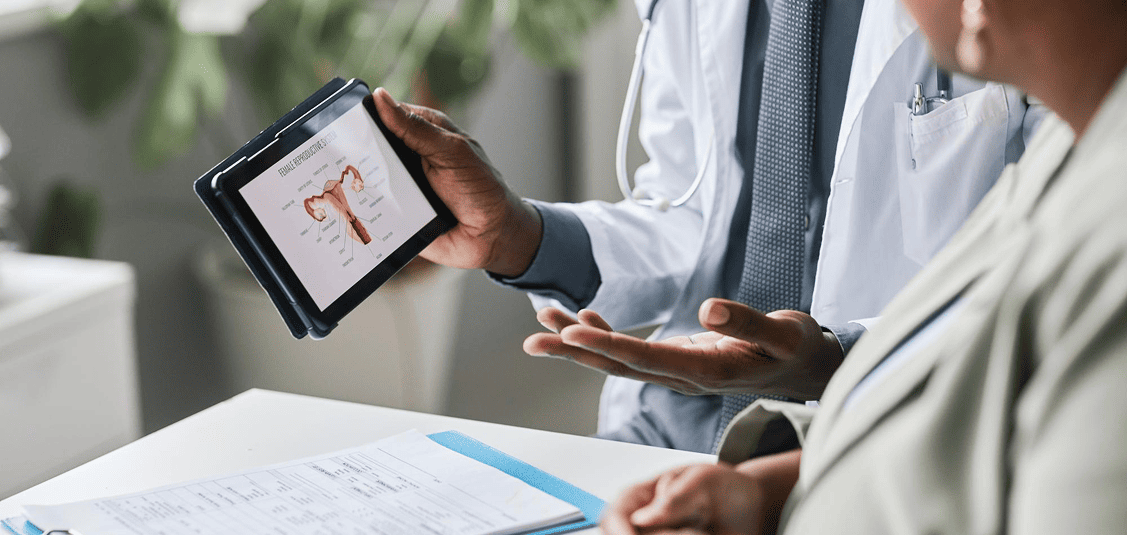
Fibroids are extremely common — most women will have at least one by the time they reach menopause — and most cause no problems at all. But when they do cause heavy bleeding, pain, pressure symptoms or affect your fertility, you deserve a treatment plan built around your fibroids specifically, not a generic protocol.
Our Fibroid Clinic provides detailed imaging to map exactly what you’re dealing with — size, number, type and position — then walks you through every treatment option available, from medication through to the least invasive procedure that will actually solve the problem.
Having fibroids doesn’t automatically mean surgery — many women are treated effectively without it.
We use detailed ultrasound, and MRI where needed, to map your fibroids by type — intramural, submucosal, subserosal or pedunculated — position and size, since this drives which treatments are realistic. From there, we talk through the full range of options: medical treatment to manage bleeding and pain, minimally invasive procedures such as uterine artery embolisation, HIFU, or targeted radiofrequency treatment, and surgical options including myomectomy for women wanting to preserve their uterus, or hysterectomy where that’s the right choice for you.
Fibroids affect fertility differently depending on their size and position — some have no impact at all, while others, particularly those distorting the uterine cavity, may need treatment before or alongside fertility treatment. We assess this specifically and coordinate directly with LUNA Fertility where relevant.
for incision-free radiofrequency ablation in more detai
No — many fibroids cause no symptoms at all and simply need monitoring. Treatment is considered when fibroids cause bleeding, pain, pressure symptoms, or affect fertility.
This depends on your specific fibroids, but options range from medication through to incision-free radiofrequency ablation, which targets fibroids precisely while protecting healthy tissue and supporting faster recovery.
Some fibroids can, particularly those distorting the uterine cavity, while others have no effect. We assess this individually as part of your fibroid mapping.
Myomectomy removes fibroids while preserving the uterus, which matters if you want to retain fertility or simply keep your uterus. Hysterectomy removes the uterus entirely and is considered when that’s the right choice for you, not the default.
Usually with pelvic ultrasound, which can identify most fibroids clearly. MRI is sometimes used for more detailed mapping before treatment, particularly surgery.
Book your Fibroid Clinic assessment and find the treatment that actually fits.