
🌸 Cycle Tracker

Ovulation
Date Calculator

Enter a few simple details to estimate your ovulation date, fertile window, and next period.

📅
Enter Your Details

The first day you started bleeding

28

Most cycles are 21–35 days. Average is 28 days.

How many days your period usually lasts

🌺
Your Cycle Estimate
💧
Next Period
🌟
Ovulation Day
🌱
Fertile Window Starts
High chance of conception
🌷
Fertile Window Ends
Fertility decreases after
🥚
Peak Fertility Day
Best day to try to conceive
Cycle Day 1 Day 28
Period
Fertile Window
Ovulation

These estimates are based on a standard 28-day cycle model and are for informational purposes only. They are not a substitute for medical advice.

An Ovulation Date Calculator helps estimate when ovulation is likely to occur in a menstrual cycle. Ovulation is the stage when an ovary releases an egg and fertility is at its highest.

The calculator uses simple details such as the first day of the last menstrual period (LMP) and the average cycle length to predict the likely ovulation day and fertile window.

While the result is only an estimate, it can help people better understand their cycle and identify the days when the chance of conception is highest.

Who Should Use an Ovulation Calculator

An ovulation calculator can be useful for many individuals who want to understand their reproductive cycle better.

People Trying to Conceive

People Trying to Conceive

Couples planning pregnancy use ovulation calculators to identify their most fertile days and improve the chances of conception.
People Trying to Conceive

Couples planning pregnancy use ovulation calculators to identify their most fertile days and improve the chances of conception.

Tracking Menstrual Cycles

People tracking menstrual health use ovulation calculators to observe cycle patterns helping them notice regular or irregular changes earlier today.
Tracking Menstrual Cycles

People tracking menstrual health use ovulation calculators to observe cycle patterns helping them notice regular or irregular changes earlier today.

Practicing Natural Planning

Individuals practicing natural family planning use ovulation calculators to identify fertile days helping them avoid or plan pregnancy more confidently.
Practicing Natural Planning

Individuals practicing natural family planning use ovulation calculators to identify fertile days helping them avoid or plan pregnancy more confidently.
Consistent Cycle Tracking

Consistent Cycle Tracking

People with regular menstrual cycles use ovulation calculators to estimate ovulation timing making fertility predictions more consistent and easier overall.
Consistent Cycle Tracking

People with regular menstrual cycles use ovulation calculators to estimate ovulation timing making fertility predictions more consistent and easier overall.
Recommended Ways to Calculate Ovulation Dates

There are several reliable ways to estimate ovulation. Each method offers different levels of accuracy depending on how detailed the tracking is.

Common ovulation calculation methods include:

  1. Online ovulation calculators
  2. Mathematical formulas based on cycle length
  3. Spreadsheet calculations
  4. Medical tracking methods
  5. Fertility tracking techniques such as temperature monitoring and cervical mucus observation


Using multiple methods together can often provide the most reliable estimate of ovulation.

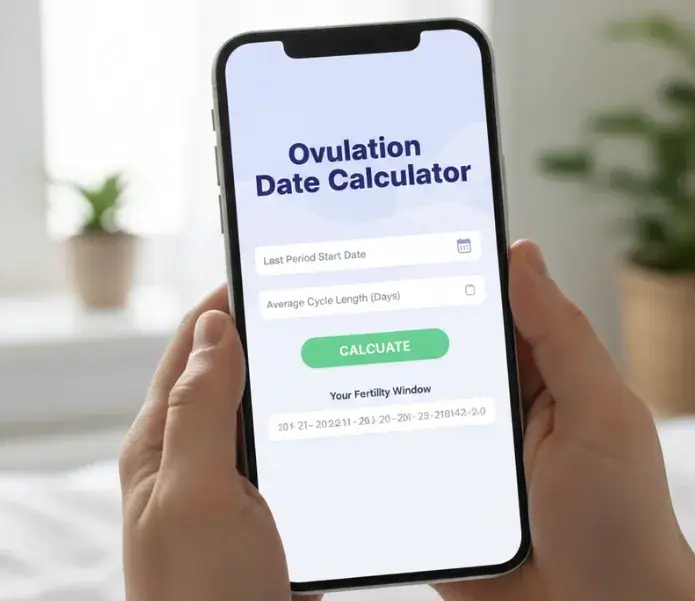
Using Our Online Calculator

An online ovulation calculator is one of the easiest ways to estimate fertile days.

Step 1: Enter Your Cycle Details

Start by giving the calculator basic information about your cycle.

  • First day of your last period (LMP) – when your bleeding started.

  • Average cycle length – usually between 21–35 days.

  • Period duration – how many days your period usually lasts.

Using Our Online Ovulation Date Calculator

Step 2: Get Your Fertility Estimates

The calculator will automatically generate your fertility information.

  • Ovulation day – the day your egg is likely released.

  • Fertile window – the days you are most likely to conceive.

  • Next period start date – when your next cycle is expected.

Step 3: Use the Results to Plan

Use the predictions to better understand and track your fertility.

  • Visual calendar – easy-to-read layout of your cycle.

  • Peak fertility day – the best day for conception.

  • Cycle tracking – helps spot patterns over time for more accurate planning.

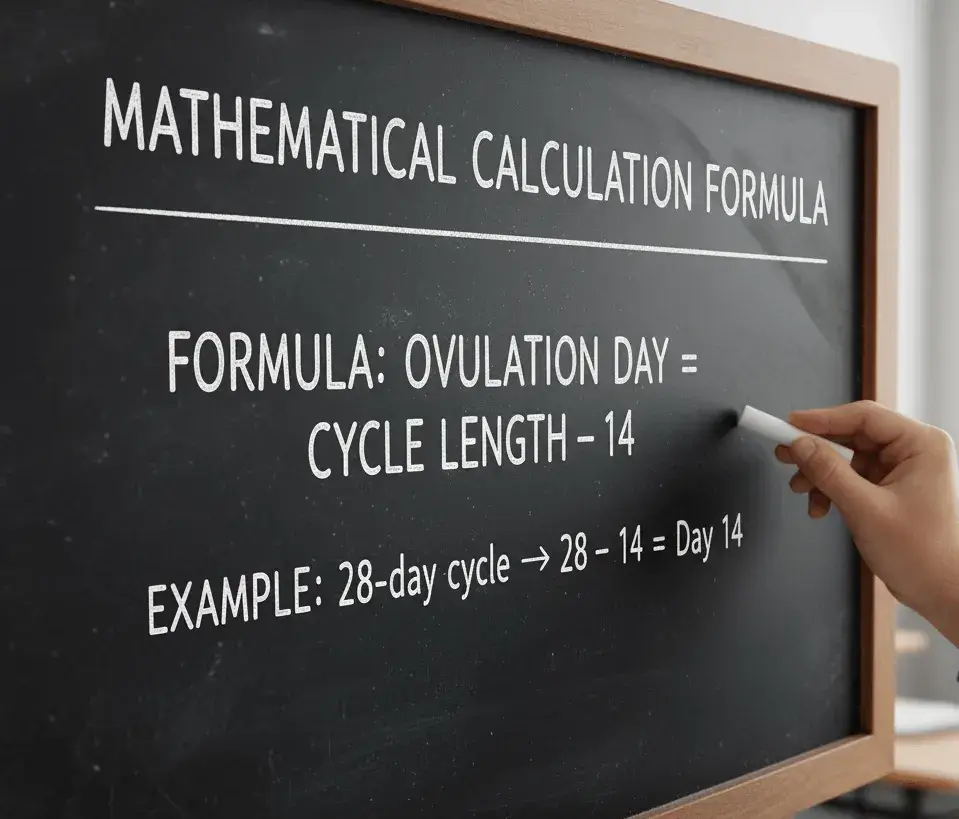
Using the Mathematical Calculation Formula

Ovulation can also be estimated using a simple mathematical formula.

Step 1: Know Your Cycle Length

Before calculating, determine the average length of your menstrual cycle.

  • Count the number of days from the first day of your period to the day before your next period starts.

  • Track a few cycles to find a reliable average.

  • Use the most consistent cycle length for accuracy.

Using the Mathematical Calculation Formula

Step 2: Apply the Ovulation Formula

Use a simple calculation to estimate your ovulation day.

  • Formula: Ovulation Day = Cycle Length − 14

  • Example: 28-day cycle → 28 − 14 = Day 14

  • This gives the approximate day when ovulation occurs.

Step 3: Determine Your Fertile Window

Once you know the ovulation day, identify the best days for conception.

  • Fertile window typically includes five days before ovulation.

  • Include the day of ovulation itself.

  • Plan accordingly for conception or fertility tracking purposes.

Using Excel or Google Sheets

Spreadsheets can be useful for people who want to track ovulation over many cycles.

Step 1: Set Up Your Spreadsheet

Create a table to organize your cycle and fertility data. Include these columns:

  • Cycle Start Date – first day of your period
  • Cycle Length – number of days in the cycle
  • Estimated Ovulation Date – calculated automatically
  • Fertile Window Start – 5 days before ovulation
  • Fertile Window End – day of ovulation

Step 2: Enter Your Data

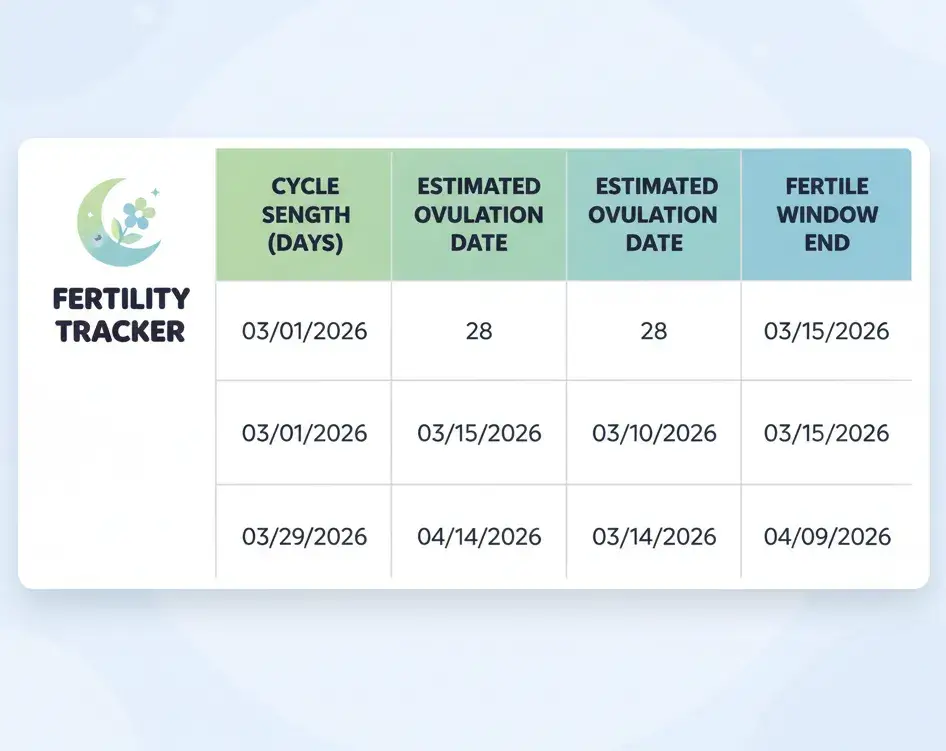
Fill in your menstrual cycle information for each month. Here’s an example template:

Cycle Start Date
Cycle Length (days)
Estimated Ovulation Date
Fertile Window Start
Fertile Window End
03/01/2026
28
03/15/2026
03/10/2026
03/15/2026
03/29/2026
30
04/14/2026
04/14/2026
04/09/2026

Step 3: Apply Formulas

Use formulas to calculate ovulation and fertile window automatically.

  • Ovulation Date: =A2 + (B2 − 14) (where A2 is cycle start date, B2 is cycle length)

  • Fertile Window Start: =C2 − 5 (five days before ovulation)

  • Fertile Window End: =C2 (ovulation day)

This setup allows you to track multiple cycles, visualize patterns, and improve ovulation prediction over time.

Medical Way to Calculate Ovulation Date

Medical methods provide more precise ovulation detection than simple calculators. Healthcare professionals may use:

  • Hormone testing
  • Ultrasound monitoring
  • Ovulation prediction kits
  • Blood progesterone tests


These methods detect hormonal changes that occur when ovulation happens, making them more accurate for people with irregular cycles or fertility concerns.

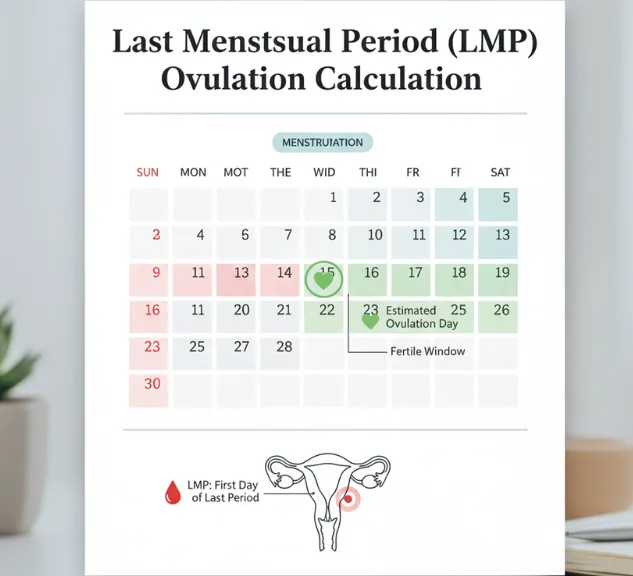
Last Menstrual Period (LMP) Ovulation Calculation

The Last Menstrual Period method is one of the most common ways to estimate ovulation.


Step 1: Identify Your Last Period

Start by noting the first day of your most recent menstrual period.

  • This is the first day of bleeding.

  • Track it accurately for precise calculation.

  • Use a calendar or app to mark the date.

Step 2: Determine Your Cycle Length

Fill in your menstrual cycle information for each month. Here’s an example template:

  • Count the days from the first day of one period to the day before the next period starts.

  • Track a few months for an accurate average.

  • Typical cycles range from 21 to 35 days.

Step 3: Calculate Ovulation Day

Use the standard formula to estimate ovulation.

  • Subtract 14 days from your cycle length.

  • Example: 30-day cycle → 30 − 14 = Day 16.

  • Day 16 is approximately when ovulation is expected.

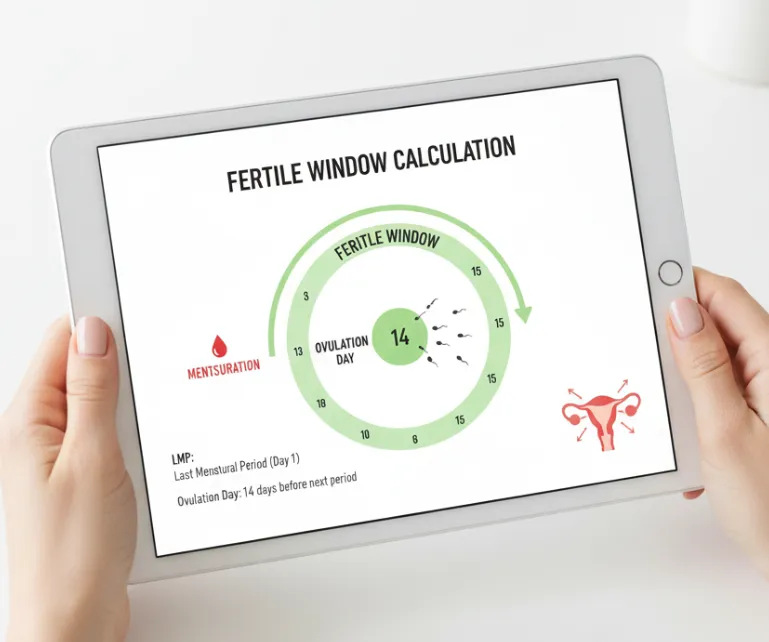
Fertile Window Calculation

The fertile window is the time during the menstrual cycle when pregnancy is most likely.

Step 1: Understand the Fertile Window

Know when pregnancy is most likely during your cycle.

  • Includes the five days before ovulation.

  • Includes the day of ovulation itself.

  • Timing matters because sperm can survive up to five days, egg only 24 hours.

Fertile Window Calculation

Step 2: Identify Your Ovulation Day

Determine when ovulation occurs using a calculator or formula.

  • Example: Ovulation on day 14 of your cycle.

  • Use past cycle data for more accuracy.

  • Can combine with fertility signs like BBT or cervical mucus.

Step 3: Calculate the Fertile Window

Mark the days when conception is most likely.

  • Example: Fertile window = days 9–14.

  • Focus on these days for trying to conceive.

  • Track over multiple cycles to identify patterns.

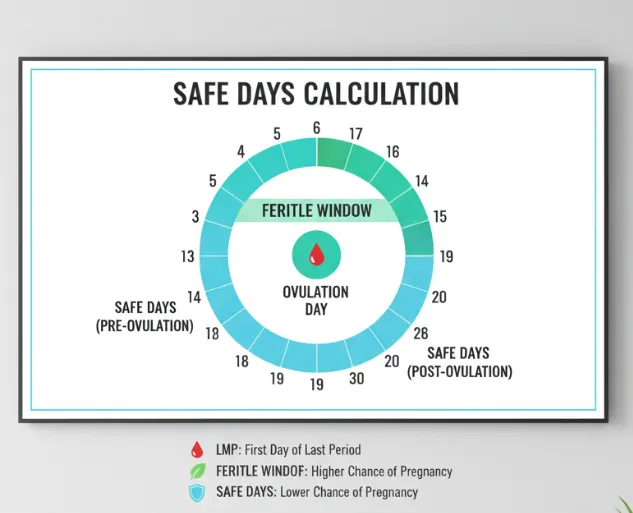
Safe Days Calculation

Safe days refer to the time in the menstrual cycle when the probability of pregnancy is relatively low.

These days usually occur:

  • Immediately after menstruation

  • After ovulation has passed

However, safe day calculations are only reliable for people with very regular cycles, and they are not considered a fully reliable contraceptive method.

Factors such as stress, illness, or hormonal changes can shift ovulation timing.

Safe Days Calculation

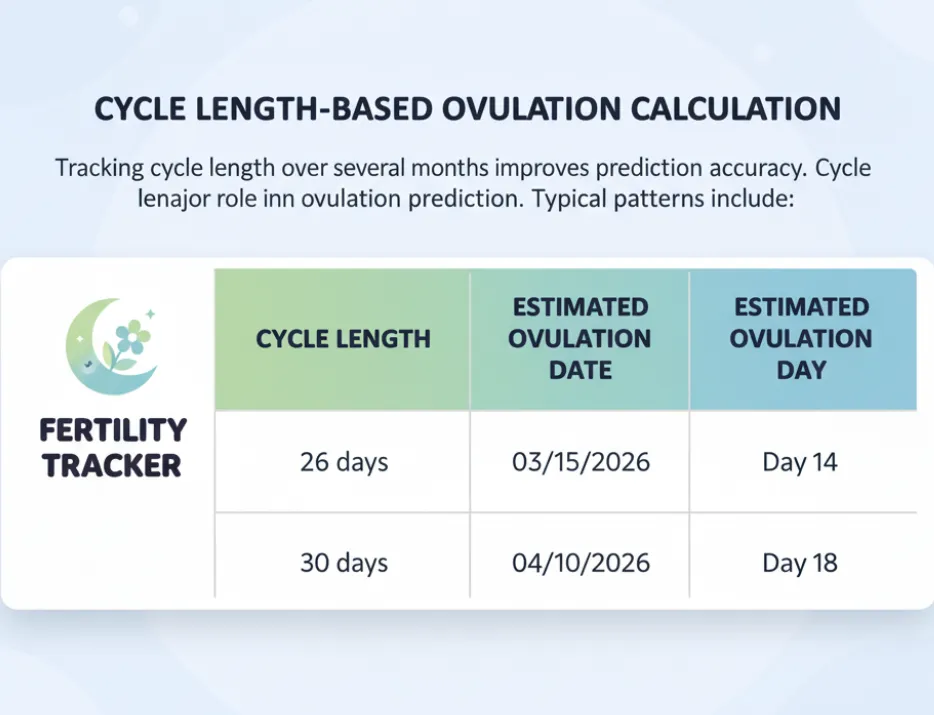
Cycle Length-Based Ovulation Calculation

Tracking cycle length over several months improves prediction accuracy. Cycle length plays a major role in ovulation prediction.

Typical patterns include:

Cycle Length
Estimated Ovulation Day
26 days
Day 12
28 days
Day 14
30 days
Day 16
32 days
Day 18

Longer cycles tend to have later ovulation, while shorter cycles ovulate earlier.

Cycle Length-Based Ovulation Calculation

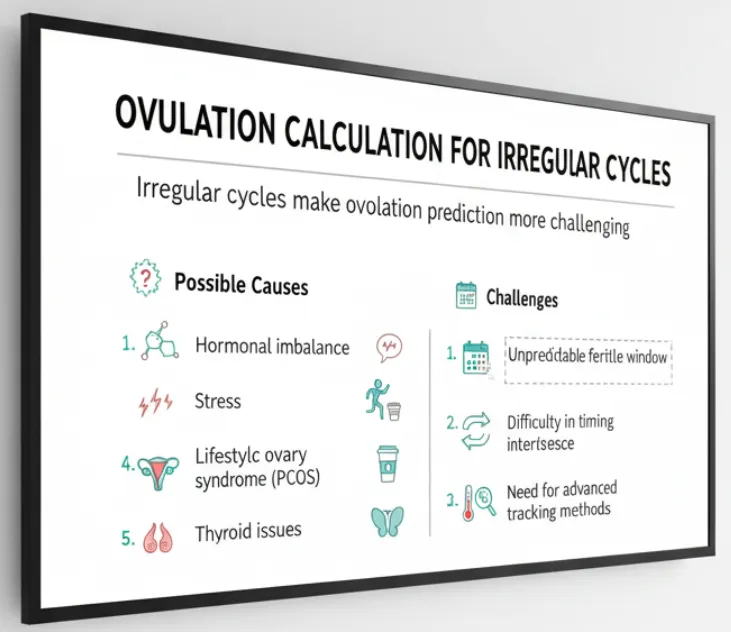
Ovulation Calculation for Irregular Cycles

Irregular cycles make ovulation prediction more challenging.

Ovulation Calculation for Irregular Cycles

Possible Causes

Irregular cycles may occur due to:

  • Hormonal imbalance

  • Stress

  • Lifestyle changes

  • Polycystic ovary syndrome (PCOS)

  • Thyroid issues

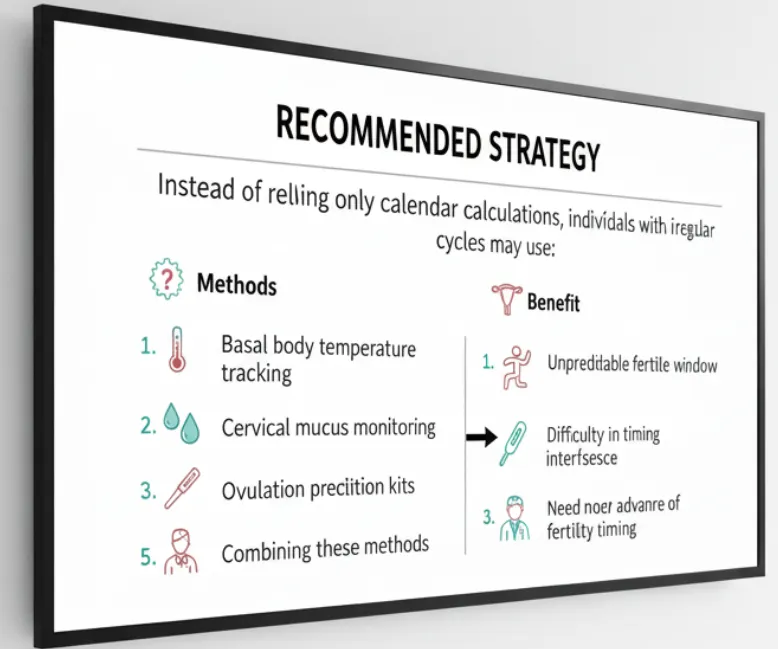
Recommended Strategy

Instead of relying only on calendar calculations, individuals with irregular cycles may use:

  • Basal body temperature tracking

  • Cervical mucus monitoring

  • Ovulation prediction kits

  • Medical consultation

Combining these methods provides a clearer picture of fertility timing.

Fertility Tracking Methods for Ovulation Calculation

Fertility awareness methods involve tracking biological signs that indicate ovulation. Common tracking techniques include:

  • Basal body temperature monitoring
  • Cervical mucus observation
  • Hormone testing
  • Ovulation prediction kits

Using multiple fertility signals often provides the most reliable estimate of ovulation.

Conception Probability Calculation

Conception probability changes throughout the menstrual cycle.

Highest Probability Days

Research suggests the highest probability of conception occurs:

  • Two days before ovulation

  • One day before ovulation

  • Ovulation day

Lower Probability Days

The chances of pregnancy decrease significantly:

  • Example: Fertile window = days 9–14.

  • Focus on these days for trying to conceive.

  • Track over multiple cycles to identify patterns.

Basal Body Temperature Ovulation Calculation

Basal body temperature (BBT) tracking measures the body’s resting temperature each morning.

Step 1: Measure Your BBT Daily

Instead of relying only on calendar calculations, individuals with irregular cycles may use:

  • Take your temperature before getting out of bed.

  • Use a digital or basal thermometer for accuracy.

                                                                                                                                                                                                                                                                                                                                                                                                                                                                                                                                                                                                                                                                                                                                                                                                                                                                                                                                                                                                                                            • Record the measurement every day at the same time.

Basal Body Temperature Ovulation Calculation

Step 2: Look for Temperature Changes

Ovulation causes a slight rise in body temperature.

  • Typically 0.3–0.5°C (0.5–1°F) increase after ovulation.

  • The rise is due to progesterone hormone.

  • Compare daily readings to spot the shift.

Step 3: Identify Ovulation

Use the temperature pattern to confirm ovulation.

  • A consistent rise indicates ovulation has occurred.

  • Helps determine your fertile window retrospectively.

  • Track over multiple cycles for more accurate predictions.

Cervical Mucus Fertility Calculation

Cervical mucus changes throughout the menstrual cycle due to hormonal fluctuations.

Cervical Mucus Fertility Calculation

Fertile Cervical Mucus

Near ovulation, mucus becomes:

  • Clear
  • Stretchy
  • Slippery
  • Similar to raw egg whites


This type of mucus helps sperm travel toward the egg.

Less Fertile Mucus

Before and after ovulation, mucus may appear:

  • Thick

  • Sticky

  • Dry

Observing these patterns helps identify the fertile window.

Less Fertile Mucus

Ovulation Prediction Kit (OPK) Result Interpretation

Ovulation prediction kits detect the luteinizing hormone (LH) surge in urine. The LH surge occurs about 24–36 hours before ovulation.

Reading Results

  • Positive result: Ovulation likely within the next day
  • Negative result: No LH surge detected yet


OPKs are widely used because they provide a more direct hormonal signal of ovulation.

Ovulation Calculation Mistakes to Avoid

Some common mistakes can reduce the accuracy of ovulation predictions.

Assuming Every Cycle Is the Same

Assuming Every Cycle Is the Same

Cycle lengths vary each month, so assuming every cycle is the same can lead to inaccurate ovulation predictions.

Assuming Every Cycle Is the Same

Assuming Every Cycle Is the Same

Cycle lengths vary each month, so assuming every cycle is the same can lead to inaccurate ovulation predictions.

Assuming Every Cycle Is the Same

Assuming Every Cycle Is the Same

Cycle lengths vary each month, so assuming every cycle is the same can lead to inaccurate ovulation predictions.

Assuming Every Cycle Is the Same

Assuming Every Cycle Is the Same

Cycle lengths vary each month, so assuming every cycle is the same can lead to inaccurate ovulation predictions.

Assuming Every Cycle Is the Same

Assuming Every Cycle Is the Same

Cycle lengths vary each month, so assuming every cycle is the same can lead to inaccurate ovulation predictions.

Assuming Every Cycle Is the Same

Assuming Every Cycle Is the Same

Cycle lengths vary each month, so assuming every cycle is the same can lead to inaccurate ovulation predictions.

Pros and Cons of Using an Online Calculator

Some common mistakes can reduce the accuracy of ovulation predictions.

Advantages

  • Simple and fast

  • Requires minimal information

  • Useful for cycle awareness

  • Helpful for initial fertility planning

Limitations

  • Based on averages rather than real-time hormone data

  • Less accurate for irregular cycles

  • Does not confirm ovulation

  • Should not replace medical advice

Final Verdict

An Ovulation Date Calculator is a simple tool to estimate your most fertile days using details like your last menstrual period and cycle length.

While helpful, ovulation can vary due to hormonal changes, stress, health, or lifestyle. Combining calculators with tracking methods improves accuracy.

For those trying to conceive, it boosts the chance of pregnancy, while others gain valuable insights into their menstrual health and cycle patterns.